Product Description
Where Courage Meets Poetry, and Love Becomes Legend.
The Antarah and Abla lamp celebrates one of the most enduring romances of classical Arabic literary tradition. Antarah ibn Shaddad, remembered as a pre-Islamic Arab poet and warrior, became renowned for verses expressing his admiration and love for Abla. Across generations, storytelling transformed their connection into a legendary tale where courage, devotion, honour, poetry, and longing become inseparable.
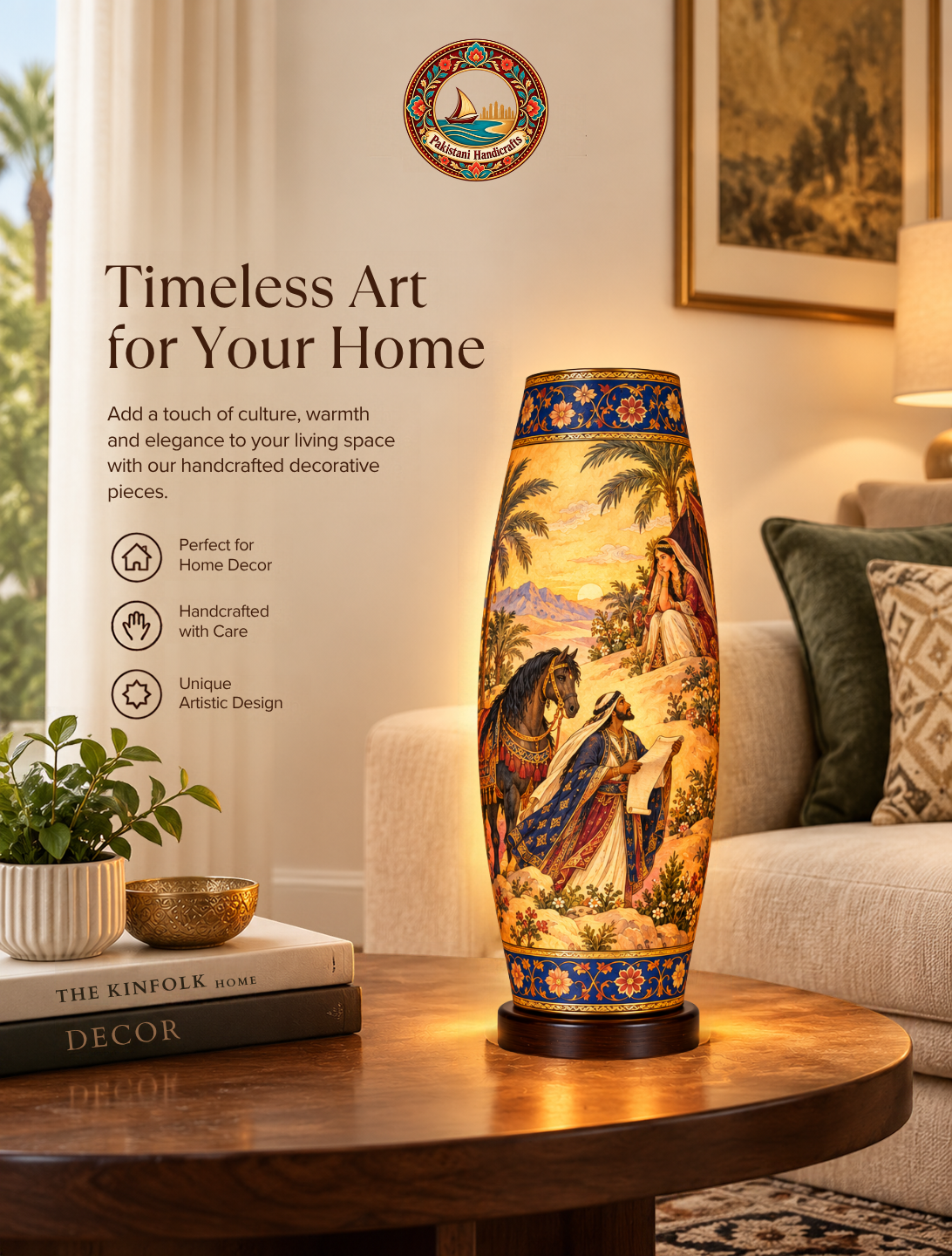
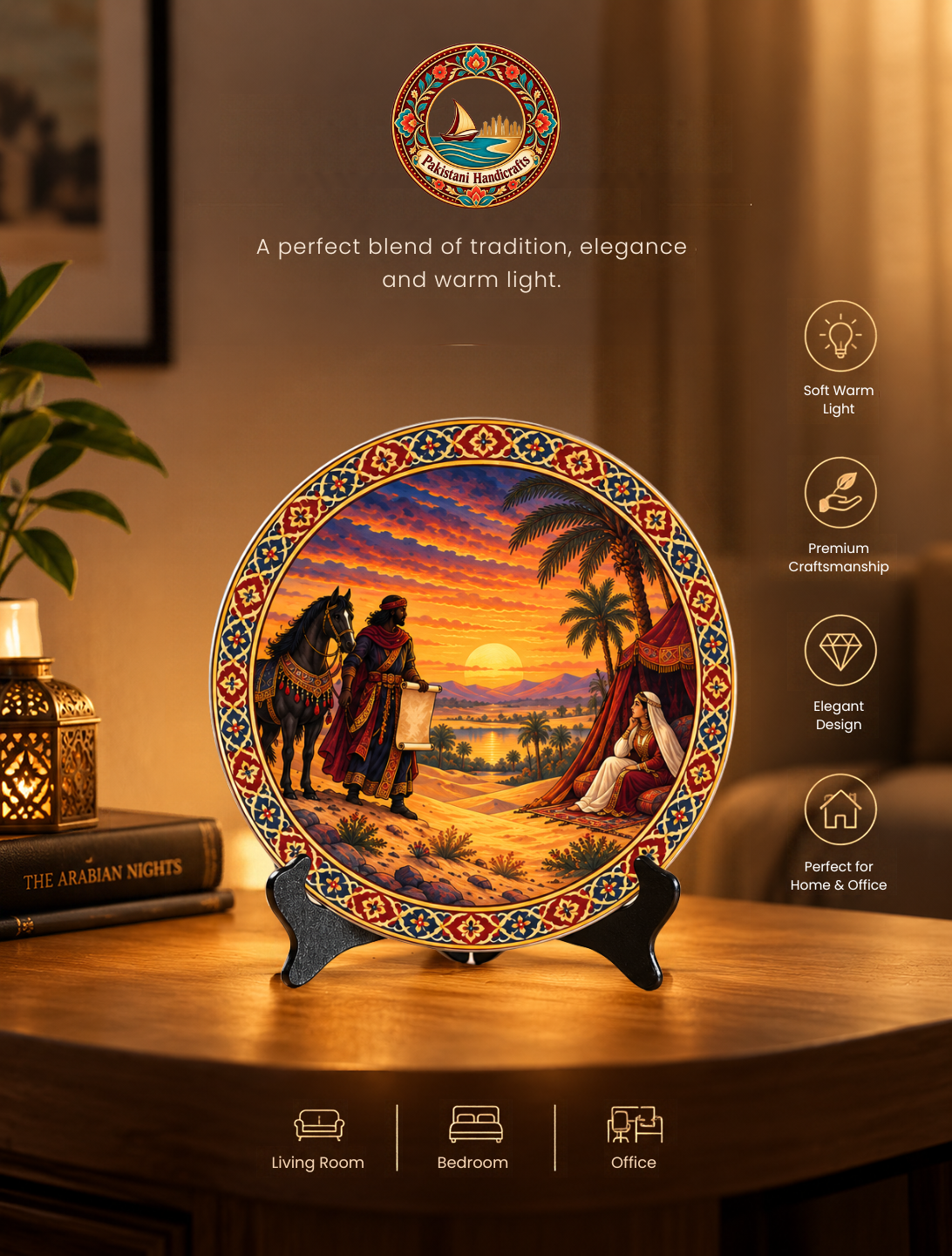
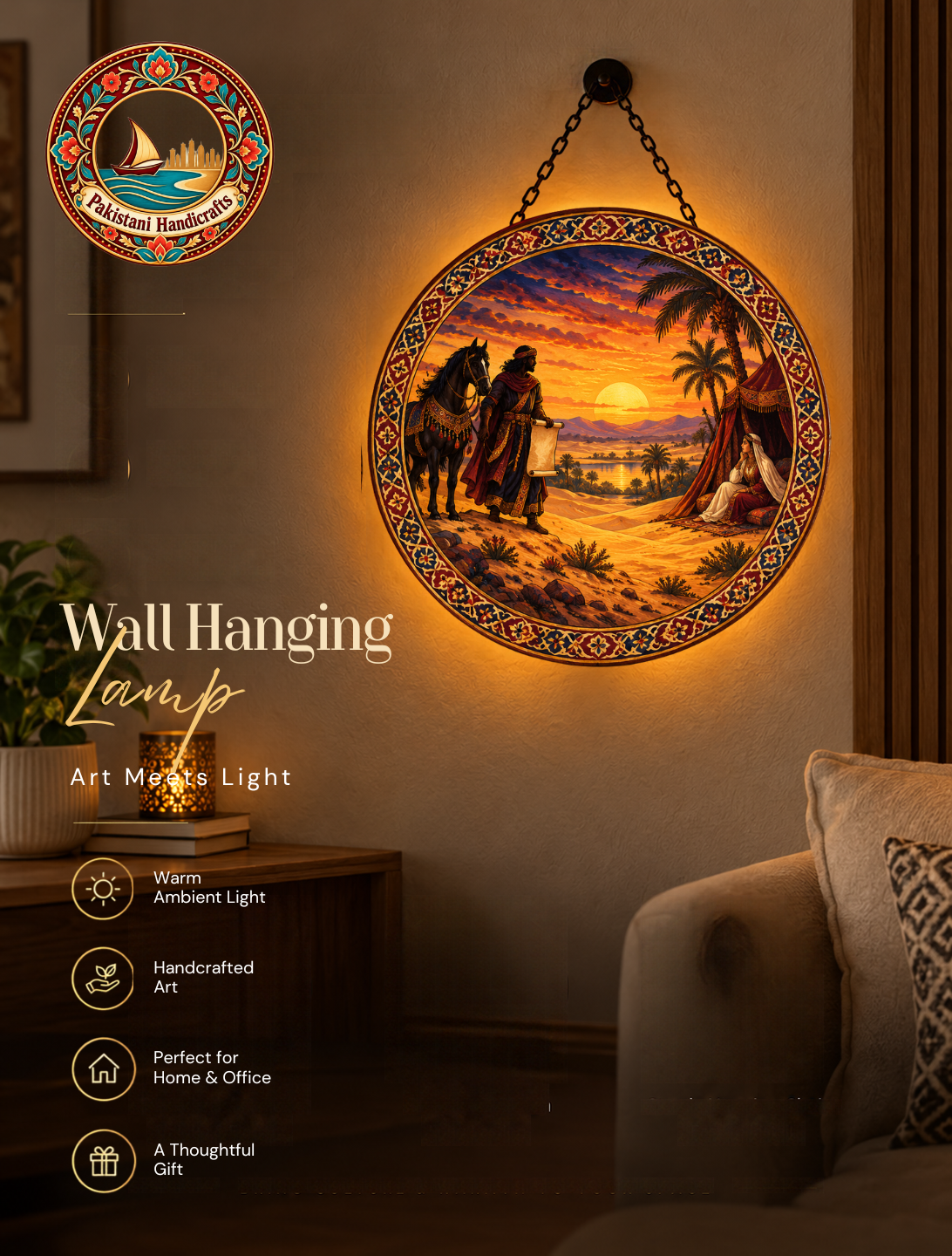
At the heart of the design, Antarah stands beside his horse in the vast desert, creating a powerful image of strength and independence. His poised figure reflects the two sides of his enduring literary legacy: the warrior defined by courage and the poet whose words express the depth of his emotions.
Resting below him is a blank poetry scroll, deliberately left unwritten. Rather than depicting a specific verse, the empty scroll symbolizes the poetry through which Antarah’s feelings continue to echo across time. It represents words waiting to be written—the emotions of admiration, longing, honour, and love that give the legend its poetic character.
Above him, Abla appears near her tent, separated from Antarah by a sweeping desert dune. Although the two figures occupy the same landscape, the distance between them remains unmistakable. The flowing dune visually connects their worlds while preserving the separation that gives the composition its emotional depth.
The horse represents strength, freedom, and the spirit of the desert. The blank scroll evokes poetry and unspoken affection, while the single dune forms a natural visual bridge between the two characters. Together, these elements create a scene in which the desert becomes more than a setting—it becomes part of the story.
Soft illumination follows the contours of the sand, the figures, the horse, and the surrounding tents, giving the landscape a warm and atmospheric quality. As the lamp glows, the contrast between Antarah’s solitary presence and Abla’s distant figure becomes more pronounced, transforming the scene into an intimate portrait of love and longing.
More than a decorative lamp, this design pays tribute to the enduring tradition of Arabic poetry and storytelling, where love, honour, bravery, and longing can become part of a cultural legacy carried from one generation to the next.
The scene is an artistic interpretation inspired by literary tradition rather than a documented historical encounter. Its purpose is to capture the emotional and poetic character of the Antarah and Abla legend through landscape, symbolism, and light.
Design Concept
Pre-Islamic Arabian Heritage Meets Romantic Literary Storytelling
The design brings together two defining aspects of Antarah’s legendary identity: the warrior and the poet. Through the desert landscape, horse, poetry scroll, distant tent, and sweeping dune, the lamp transforms a literary romance into an illuminated visual narrative.
At its centre is the idea that courage and poetry can exist within the same story—that a warrior’s strength can coexist with deep emotional expression.
Antarah — The Warrior and the Poet
Antarah forms the primary figure of the composition, standing confidently beside his horse.
His upright posture communicates strength and courage, reflecting his image within classical Arabic literary tradition as both a warrior and poet. Yet the presence of the blank scroll introduces another dimension to his character.
He is not shown only as a figure of battle and bravery, but as a man whose emotions find their deepest expression through poetry.
This contrast gives the central figure much of the design’s character: strength on the outside, poetry within.
The Horse — Strength and Freedom
The horse stands beside Antarah as a natural extension of the desert setting.
Its presence reinforces the image of the warrior while introducing a sense of movement, freedom, and connection to the Arabian landscape. The horse also gives the composition a strong horizontal presence, balancing Antarah’s upright figure against the open desert.
Together, horse and rider create an image of independence and strength while remaining grounded within the poetic atmosphere of the scene.
The Blank Poetry Scroll — Words Waiting to Be Written
The empty scroll is one of the most meaningful details in the design.
Rather than reproducing a specific poem, the blank surface represents the possibility of poetry itself. It suggests feelings that have not yet been written down and words that remain suspended between thought and expression.
The scroll therefore becomes a symbol of Antarah’s poetic legacy and the role of poetry in transforming personal emotion into something that can endure beyond a single lifetime.
Abla and the Tent — The Beloved in the Distance
Abla appears near her tent in the distance, providing a visual counterpoint to Antarah.
Her placement keeps her connected to the same landscape while making her physically distant from him. The tent establishes a subtle sense of place and adds depth to the desert composition.
Her presence is intentionally quiet. She does not dominate the scene; instead, she becomes the distant figure toward whom the emotional narrative is directed.
The Desert Dune — A Natural Bridge
The sweeping dune is central to the composition.
It rises between Antarah and Abla, separating them while simultaneously connecting their positions within the landscape. Its flowing shape creates a natural visual pathway through the scene, guiding the eye from one character toward the other.
The dune therefore carries a dual meaning: it is both a barrier and a bridge.
It expresses the physical distance between the lovers while suggesting that their emotional connection persists despite that separation.
The Desert — A Landscape of Legend
The open desert provides the ideal setting for the story.
Its vastness emphasizes the smallness of the human figures while giving their relationship a sense of timelessness. The sweeping landscape creates room for solitude, reflection, movement, and longing.
Rather than simply functioning as a background, the desert becomes an emotional landscape—wide enough to contain both the distance between the characters and the enduring story that connects them.
Light — Bringing Poetry Into the Landscape
Soft illumination reveals the details of the composition gradually.
The glow traces the curves of the sand dunes, highlights the figures of Antarah and Abla, and brings subtle attention to the horse, scroll, and tents. This creates a warm nighttime atmosphere that feels both intimate and expansive.
As light passes through the design, the desert appears almost dreamlike, allowing the legendary story to emerge from shadow and become part of the surrounding space.
The Meaning Behind the Design
The Antarah and Abla lamp is ultimately a story about how love, courage, and poetry can survive through time.
Antarah’s strength is represented through his stance and horse, while his emotional world is represented through the poetry scroll. Abla remains distant, and the desert stretches between them, yet the dune creates a visual connection that prevents the two figures from ever feeling completely separate.
The composition suggests that distance does not necessarily erase connection. Sometimes, it is precisely longing and separation that inspire the words through which a story survives.
Symbolism
- Antarah: Represents courage, honour, strength, and poetic expression.
- Abla: Represents the beloved who inspires admiration, devotion, and poetry.
- The Horse: Symbolizes strength, freedom, movement, and the spirit of the desert.
- The Blank Scroll: Represents poetry, unspoken affection, and emotions waiting to become words.
- The Desert Dune: Symbolizes both separation and the enduring connection between the two characters.
- The Tent: Provides a sense of place while representing Abla’s distant world.
- The Warm Light: Suggests the enduring nature of memory, storytelling, and love.
Perfect For
Cultural interiors, literary collections, traditional décor, artistic spaces, heritage-inspired interiors, premium gifts, and admirers of Arabic poetry, classical Arabian literature, and legendary romances.
 Doha, Qatar
 Cash on Delivery in All over Qatar


Reviews
There are no reviews yet.